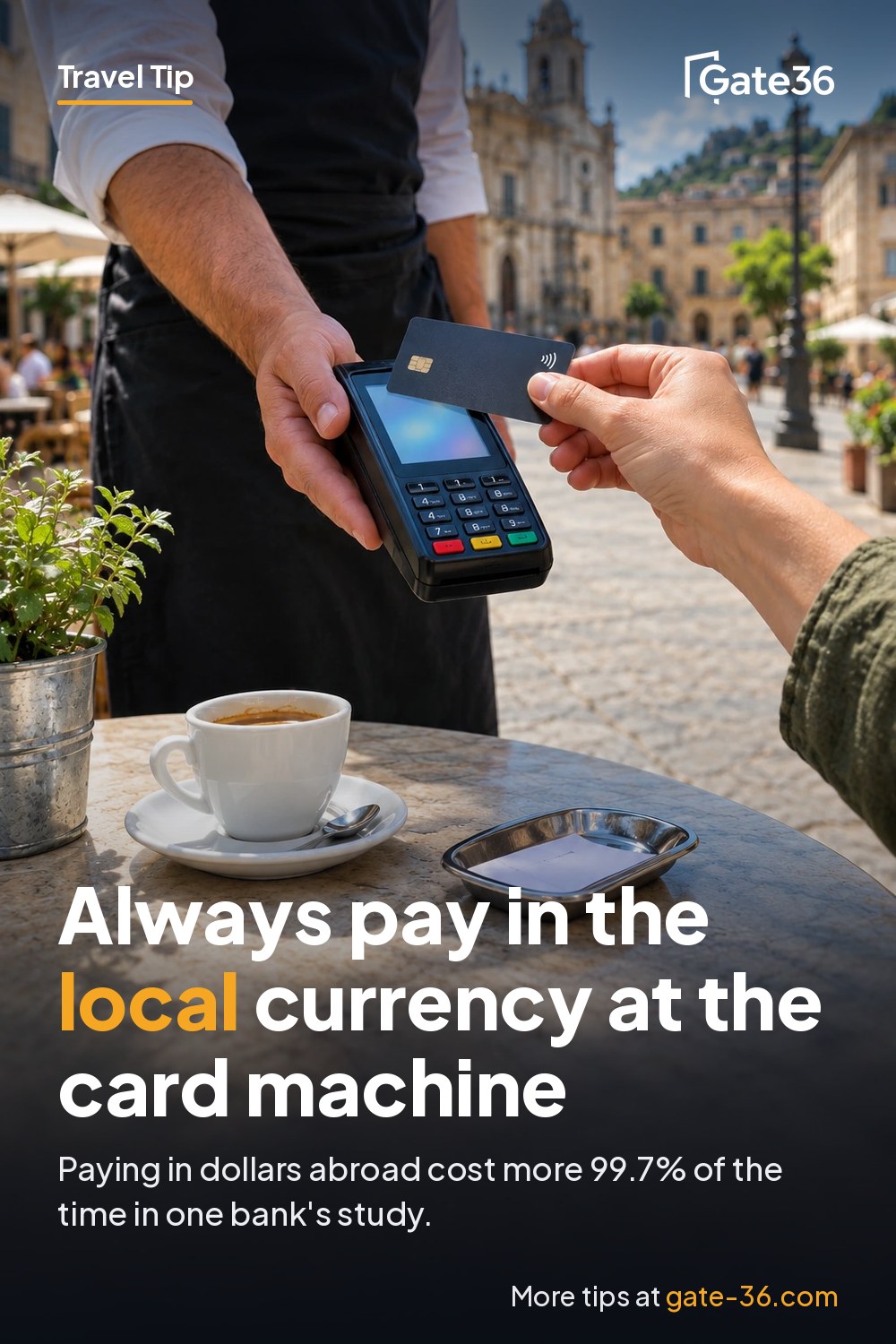
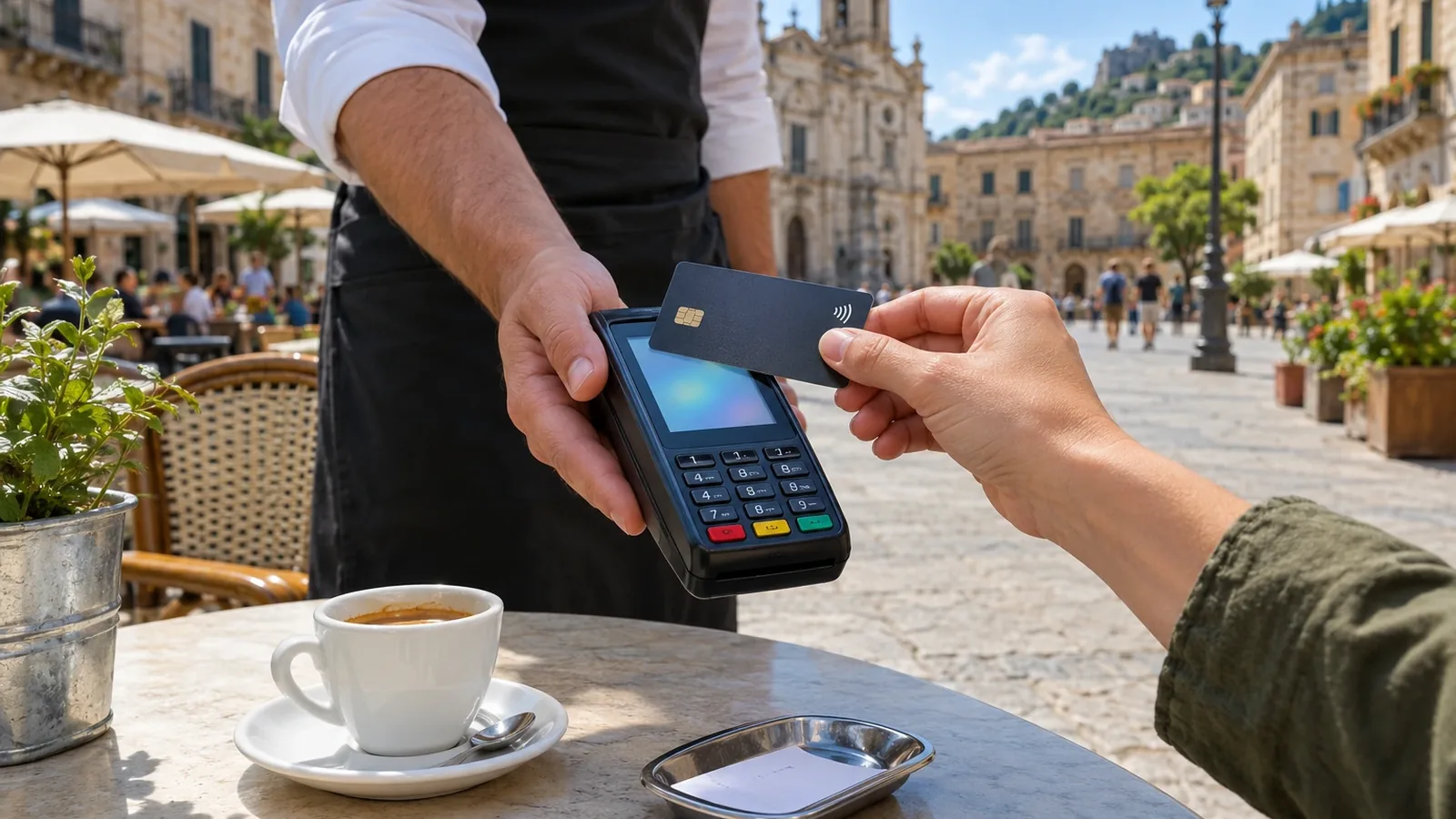
TL;DRWhen the terminal or ATM shows two amounts, choose the local currency (euros in Europe, yen in Japan), never your home currency. If someone picks dollars for you, ask them to cancel and run it again in local currency.
You hand over your card at a cafe in Lisbon or a shop in Rome, and the terminal asks: pay in euros or pay in US dollars? Dollars feel safer because you know exactly what you are paying. That feeling is the trap. Always pick the local currency.
A Norwegian bank checked 1,500 random ATM withdrawals its customers made around Europe in 2016. Choosing the home currency cost more in 99.7% of cases. Only 4 of the 1,500 came out cheaper, and the biggest gap was 12.4%, counting the bank's own 1.75% fee (Norwegian Consumer Council, 2017).
Why this matters
The option has a name: dynamic currency conversion (DCC). When you accept it, the shop's or ATM operator's payment provider converts the price into your home currency at an exchange rate it sets, and that rate can include a markup and fees. Visa's page on DCC says as much and asks merchants to show you those costs.
When you decline it and pay in the local currency, your card network (Visa or Mastercard) does the conversion at its own rate, and your bank adds its foreign transaction fee if your card has one. With a card that charges no foreign transaction fee, that is usually the cheapest way to pay abroad.
The losses add up. BEUC, the umbrella group of European consumer organizations, cited a German consumer test (Stiftung Warentest) that found people almost always lose when they choose the home currency, and an estimate that DCC costs UK consumers around £500 million a year (BEUC, March 2018).
To put a markup in trip terms: a 5% markup adds €2.50 to a €50 dinner. Over a two-week trip with €2,000 on your card, the same 5% is about €100. At the 12.4% worst case from the Norwegian study, it would be about €248.
How it shows up
- Card machines: the screen shows two amounts, one in the local currency and one in yours, often with an exchange rate. The buttons usually name the currency, for example EUR and USD.
- ATMs: after you enter the amount, the screen offers to convert it, often as a choice to accept "with conversion" or "without conversion". The wording confuses people: in a Norwegian survey, 42% said they would pick "with conversion", the expensive option.
- Restaurants: the waiter brings a handheld terminal and sometimes picks the currency before handing it to you.
- Hotels and car rentals: the desk may ask whether you want to be charged in dollars. The same rule applies.
- Online: foreign websites and booking apps can show the same choice at checkout, in your home currency or theirs. Pick theirs.
How to do it
- Look for two amounts. If the screen shows your home currency at all, you are being offered DCC.
- Tap the local currency. Euros in the euro area, pounds in the UK, yen in Japan, and so on. Ignore labels like "guaranteed rate" or "no surprises".
- At an ATM, decline the conversion. Choose the option without conversion, then confirm the amount in the local currency.
- If someone chose for you, ask them to cancel. Say "local currency, please" before you tap or enter your PIN. A charge can be voided and run again.
- Check the receipt. Under Mastercard's rules, a DCC receipt shows both amounts and the exchange rate. Your home currency on the receipt means DCC was applied.
Your rights (as of October 2026)
You do not have to argue your case. The card networks' own rules are on your side:
- Visa says merchants and ATMs should give you the choice to accept or decline the conversion, must not choose for you, must show the exchange rate, any fees or markup and both amounts, and must not steer you with design tricks like a bigger button (Visa).
- Mastercard says the cardholder must not be required or encouraged to use DCC, that no conversion method may be the default, that DCC must never be selected when the cardholder is not there, and that the rate, fees and both amounts must be shown before you approve the payment (Mastercard DCC guide, 2021).
- In the EU, whoever offers the conversion at an ATM or a till must show its total cost as a percentage markup over the European Central Bank's latest reference rate before you pay (Regulation (EU) 2021/1230, Article 4). EU card issuers must also send you an electronic message with their own conversion charges after a card payment in another EU currency, and you can opt out of it. The ECB reference rates are published around 16:00 CET on working days, so you can check the markup yourself.
Saying no never blocks the payment. Visa notes that declining the conversion does not affect your purchase.
If it already happened
If you notice before you leave, ask the merchant to void the charge and run it again in the local currency. If you only notice on your statement and you did not agree to the conversion, contact your card issuer. Visa tells cardholders who were pressured or not given a choice to report it to their issuer, and Mastercard's rules let the issuer file a chargeback when DCC was applied without the cardholder's consent. Keep the receipt, since it shows the rate you were charged.
Common mistakes
- Trusting the familiar number. Seeing the price in dollars feels clear, but that clarity is what you pay for.
- Thinking a no-fee card protects you. A card without foreign transaction fees waives your bank's fee, not the markup built into a DCC rate.
- Rushing the tap. Restaurant terminals are handed over quickly. Read the screen before you tap.
- Mixing up the ATM fee and the conversion. Some cash machines charge an access fee and also offer conversion. They are separate choices, so decline the conversion even if you accept the fee.
- Not checking after a quick payment. If a contactless tap went through fast, glance at the receipt or your card app before you walk away.
Bottom line
When a card machine, ATM or checkout page abroad offers your home currency, choose the local currency every time. Card network rules make it your choice, and in a study of 1,500 withdrawals the local currency was cheaper 99.7% of the time.
Sources
- Visa: Dynamic currency conversion
- Mastercard: Dynamic Currency Conversion performance guide (2021)
- Regulation (EU) 2021/1230 on cross-border payments, Article 4
- ECB: Euro foreign exchange reference rates
- Norwegian Consumer Council: Input to the European Commission on DCC (June 2017)
- BEUC: An end in sight to currency conversion scams (March 2018)
- Visa: Exchange rate calculator